The short version
- Track three or four measures tied to what you are working on. More than that and you will stop.
- Record a baseline before you change anything.
- Repeat the same test in similar conditions, so you are comparing like with like.
- One session proves nothing. Look for a direction across four or five.
- Use session numbers for practice and confirmed results for the bigger picture.
You have been practising your backhand for two months. Some weeks it feels solid, some weeks it falls apart, and you could not honestly say whether it is better than it was in the summer. Most adults who play regularly are in this position: plenty of hours, no evidence.
Learning how to track tennis progress fixes that. It does not take a spreadsheet or a coach standing behind you. It takes a few measures, a starting point and the discipline to repeat the same test.
Why it is hard to tell whether your tennis is improving
Feel is unreliable. A session where you timed the ball well feels like progress, even if half the shots landed short. A session in the wind feels like a step back, even if your technique held up.
Results are slow and noisy. You can play better and lose to a stronger opponent, or play worse and win. Over a season results tell the truth, but over a month they tell you very little.
And change is gradual. You see your own game every week, so a slow improvement is as invisible as a child growing. You need a fixed point to compare against.
How to track tennis progress: choose what to measure
Choose three or four measures that match what you are trying to improve. Fewer is better. A list of twelve becomes a chore by week three.
Good measures are ones you can count and repeat:
- Reliability: how many forehands or backhands land in.
- Serve: first serves in, second serves in, typical speed.
- Depth: where your rally balls bounce.
- Errors: unforced errors in a set, and which shot they came from.
- Movement: how well you recover to the middle after each shot.
If you are unsure which to pick, the tennis stats that matter for club players covers what each one tells you.
Pair an outcome with whatever you are changing. If you are adding topspin to your backhand, track spin and backhands landed in together. Spin going up while accuracy collapses is not progress yet.
Record a baseline before you change anything
The first recording is the most valuable one you will make, because you can never go back and get it later.
Before you start a new drill, lesson block or technical change, record one or two ordinary sessions. Do not try to play well. The aim is an honest picture of your normal game.
Two sessions are better than one. If the numbers differ, the gap between them shows you how much your game varies from day to day, which you will need to know later.
Repeat the same test
A comparison only means something if the two things being compared are alike. Fifty forehands off a ball machine and fifty forehands in a tight set are different tests.
So build a small test you can repeat. For example: after a warm-up, twenty first serves to each side, then a ten-minute cross-court rally with a partner. Same court if possible, similar balls, similar time of day. Run it every two or three weeks.
Ball machine sessions are especially good for this, because the feed is the same every time. See how to improve with a ball machine for setting one up.
How to measure tennis improvement with video
You can count by hand, and for serves in a basket it works fine. For anything involving rallies, speed, spin or depth, counting by hand is slow and rough.
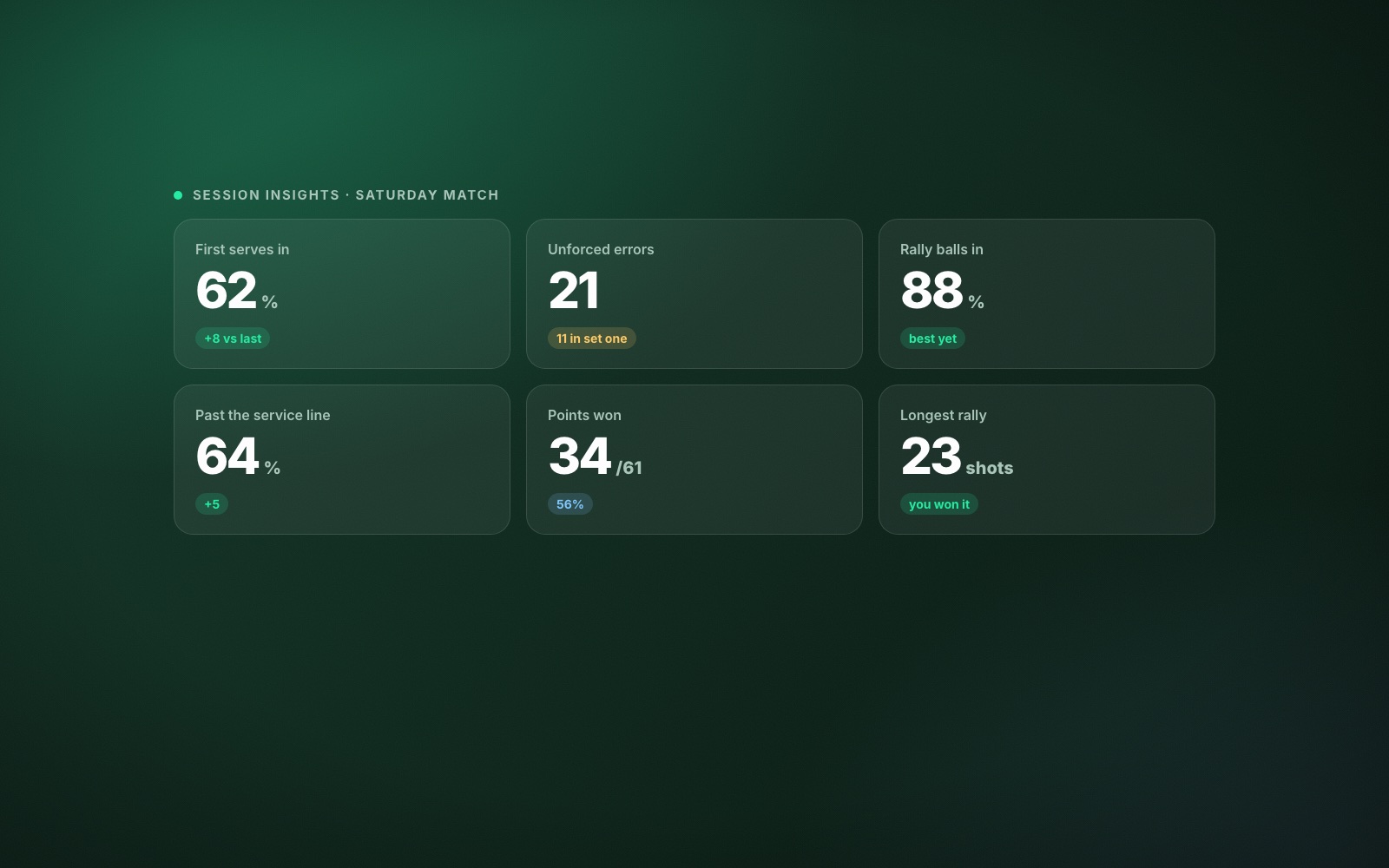
ContactFrame does the measuring from one phone on a tripod behind the baseline. For every shot it records ball speed, spin, where the ball bounced and an in, out or close call, then breaks the session down by shot type. Movement figures cover how far you moved, where you stood, how well you recovered to the middle and how often you were ready when your opponent hit. Each session also gets a shot quality score out of 100.
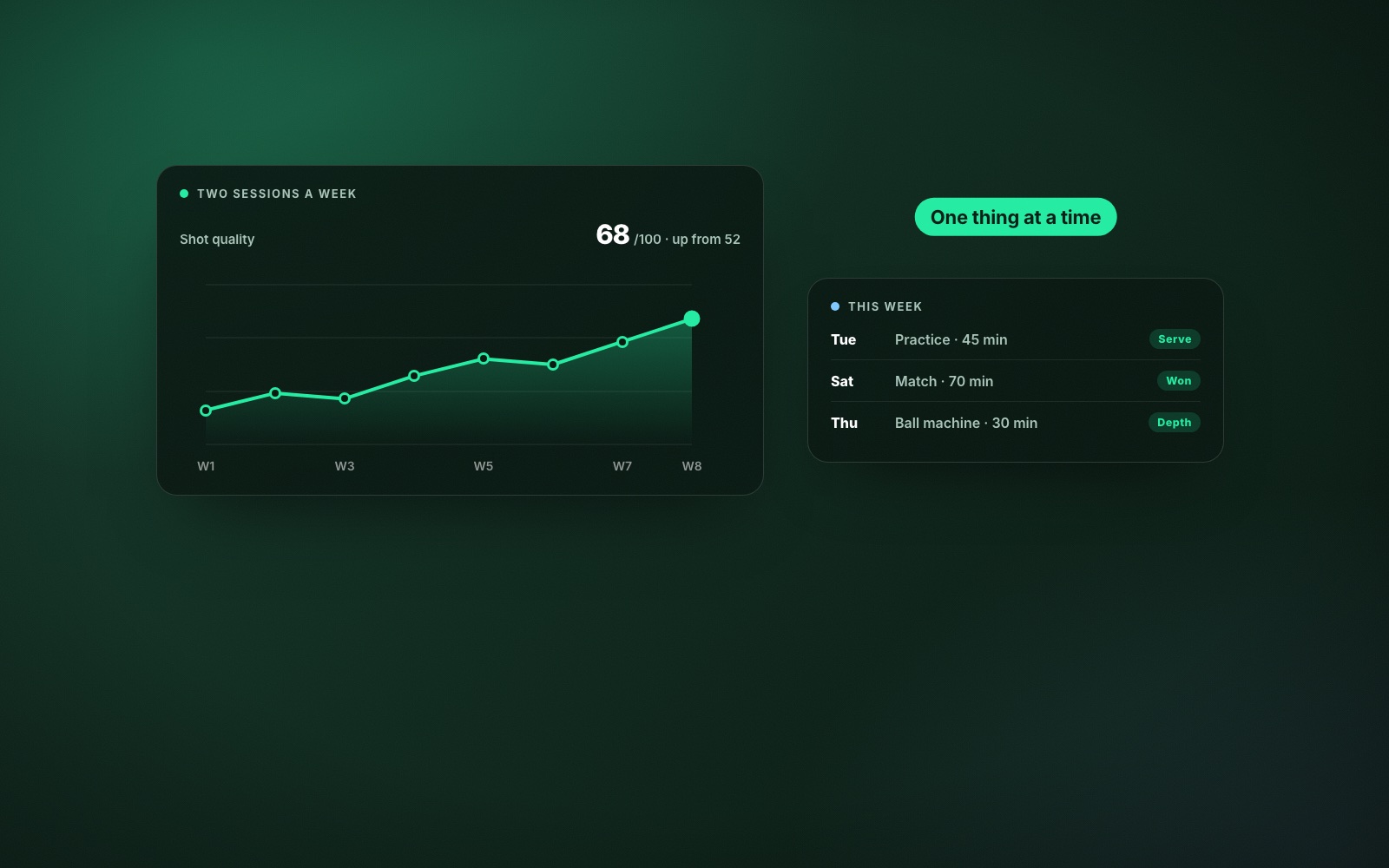
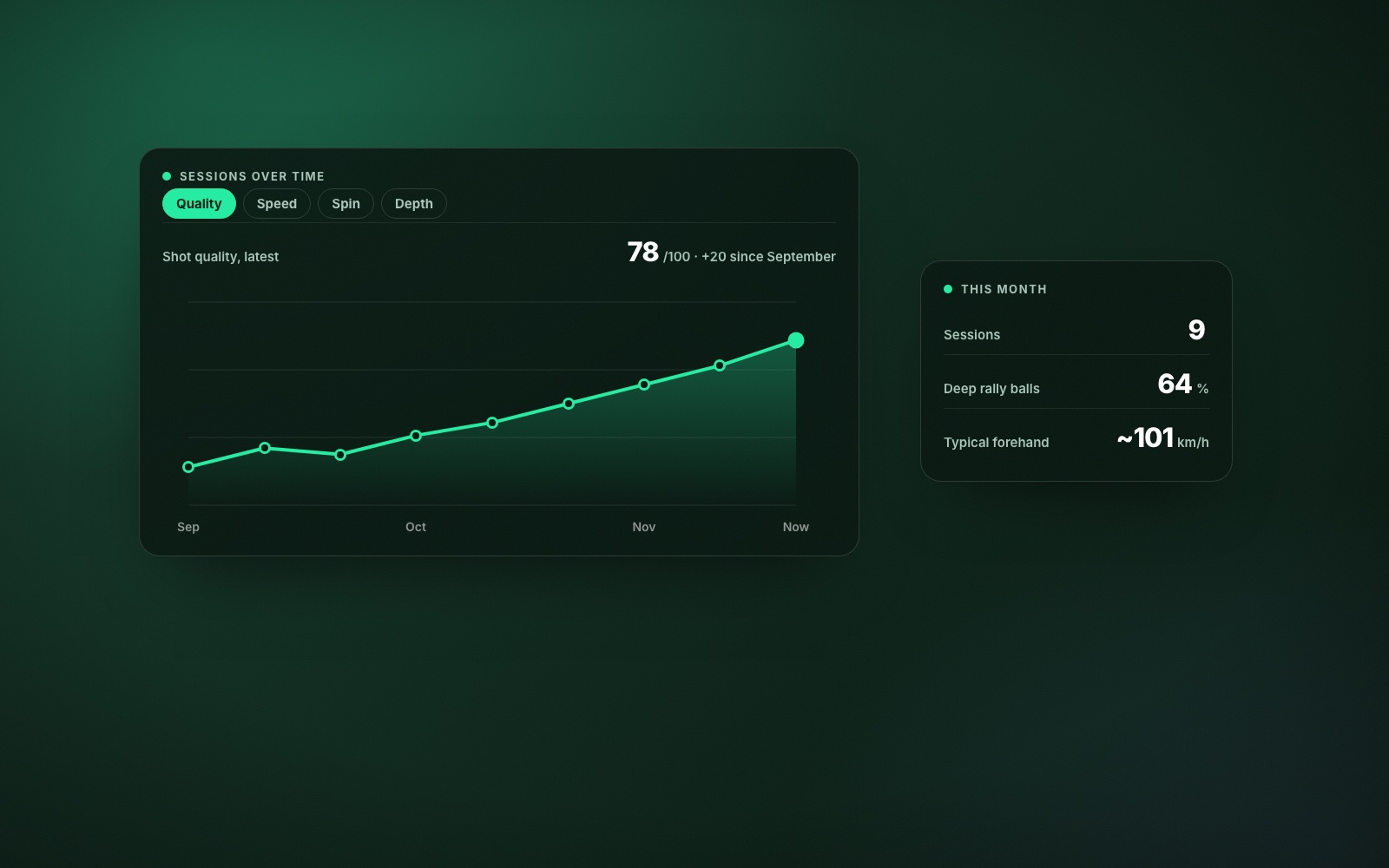
The part that matters for tracking is trends: the same measures laid out session after session, so you can see whether a change stuck. You can also set a session focus, Depth, Consistency, Topspin, Power or Placement, to keep a block of sessions pointed at one thing.
ContactFrame does not show a number it is unsure of. A doubtful speed is left blank or marked approximate, and spin appears only when the reading is solid. For tracking, that matters: a trend built on guesses is worse than no trend. You can try it in The Lab, where the free plan includes 15 minutes of recording a month, enough for a short repeatable test.
Telling real improvement from a good day
This is where most tracking goes wrong. People see one good session and declare the problem solved, or one bad one and abandon the change.
- Look at four or five sessions, not one. A direction across several sessions is evidence. A single jump is weather.
- Compare with your normal variation. If your backhand in rate bounced between 58% and 66% before you changed anything, then 64% afterwards is not news. A steady run in the low 70s is.
- Expect a dip. A technical change often makes the numbers worse for a couple of weeks before they recover. That is normal, and a reason to keep the baseline in view.
- Check it holds in a match. A gain that appears in practice but not in matches is half finished. Record a Match session in ContactFrame every so often and look at the same measure there.
A simple routine for tracking your tennis
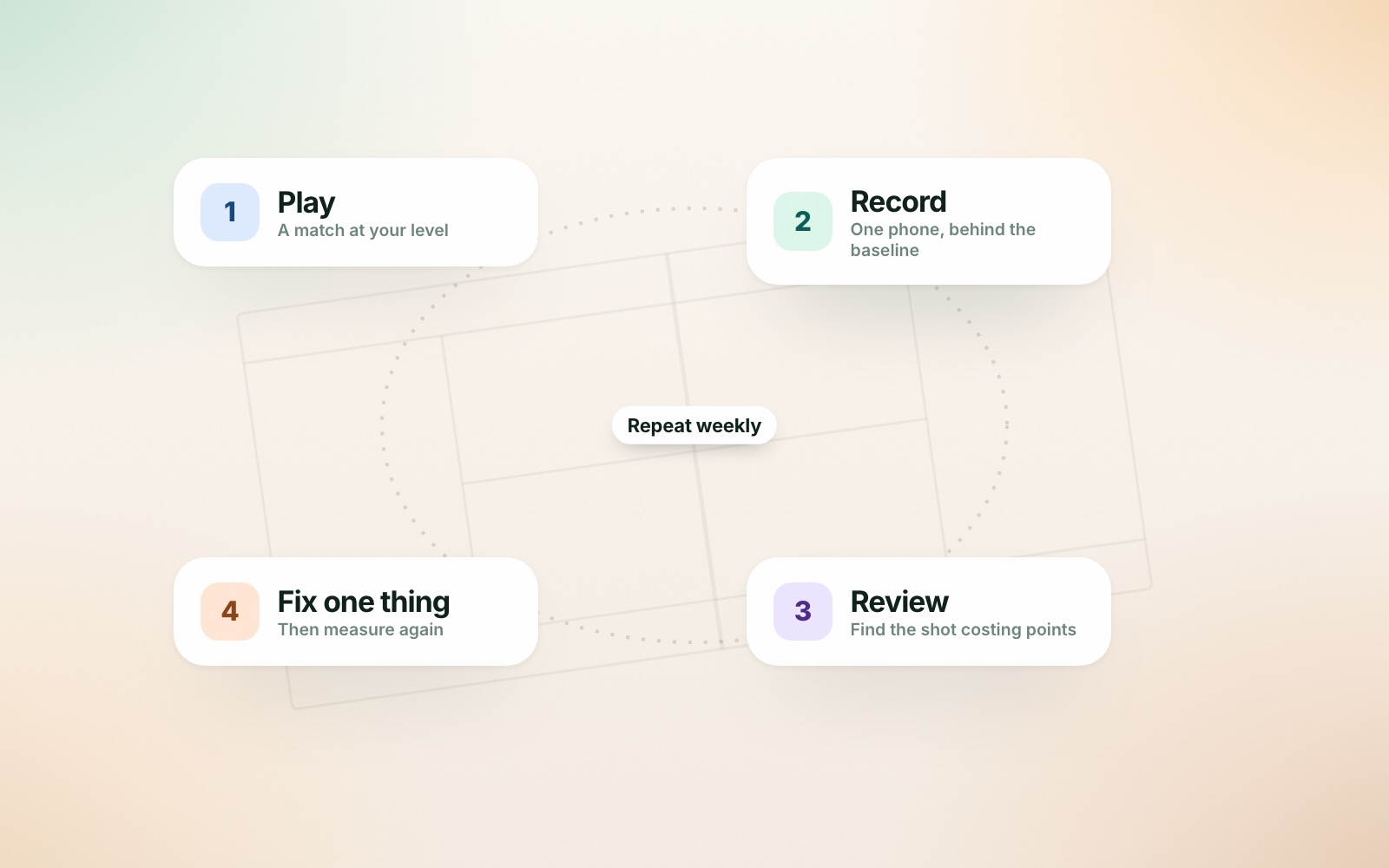
- Weeks one and two: record two baseline sessions. Choose one thing to work on and three measures.
- Weeks three to six: practise the change. Record your repeatable test every two weeks.
- Week seven: record a match. Compare practice numbers, match numbers and baseline.
- Then decide: keep going, adjust, or move on to the next thing.
After each session, write two lines: what you worked on and what you noticed. Numbers show what changed. Notes remind you why. For the wider question of where to spend limited practice time, see how to get better at tennis fast.
Tracking progress through results
Session numbers show whether a skill is improving. Results show whether it is winning you matches. Both are worth watching, on different timescales.
For UK players, The Ladder gives a Skill rating built from confirmed results, so it moves only when matches are played and confirmed. It is a slow, honest measure. Check it over months, not weeks, and expect it to lag behind what you see on the practice court. The background is in how the ContactFrame Skill rating works.
What tracking cannot do
Measuring is not practising. A folder of recordings does nothing unless each one changes what you do in the next session.
It also cannot tell you what to change in your technique when a number refuses to move. If you have worked on something sensibly for six weeks and the trend is flat, that is useful information. Take it, and the clips, to a coach. A flat line is a much better starting point for a lesson than “my backhand feels off”.
Common questions
How do I know if I am improving at tennis?
Pick a few things you can count, such as first serves in or backhands landed in, measure them now, and measure them the same way in a few weeks. If the numbers move in the right direction over several sessions, you are improving.
How long does it take to see improvement in tennis?
A single, focused change often shows in practice numbers within three to six weeks of regular work. It usually takes longer to show in matches, and longer again to show in results or a rating.
What should I track in a tennis journal?
The date, what you worked on, two or three numbers, the conditions and one line on how it felt. Keep it short enough that you will still be filling it in three months from now.
Why do I play well in practice but not in matches?
Practice removes pressure, score and an opponent trying to make you uncomfortable. Track the same measure in both settings. The gap between them tells you whether the skill is missing or simply not yet holding up under pressure.
Is there an app to track tennis progress?
Yes. ContactFrame records sessions from one phone on a tripod and shows the same measures session after session in its trends, so you can see whether a change has stuck.
See whether the change stuck.
ContactFrame shows the same measures session after session, so progress is something you can see.
Explore the Lab