The short version
- Club serve speeds are well below professional ones, and they vary enormously from player to player.
- A good serve speed is one you can land in most of the time.
- Placement and a reliable second serve win more club points than an extra 10 km/h.
- Measure speed alongside serves in and where they landed, never alone.
- Your own trend over a few weeks is the comparison that matters.
You watch a professional hit a 210 km/h ace, then go to the club and wonder what your own serve is doing. It feels quick. Your doubles partner says it is quick. But you have never seen a number, and you have no idea whether the average tennis serve speed at your level is 90 km/h or 160.
This guide gives rough ranges for club players, explains why they are rough, and makes the case that a good serve speed is not the same thing as a fast one.
What is the average tennis serve speed at club level?
The honest answer is that nobody has a reliable figure. Club players are rarely measured, and the range between a new adult player and a strong county-level one is huge. Treat everything below as general orientation from common tennis knowledge, not as a standard.
- Newer adult players: first serves often somewhere around 70 to 110 km/h. Getting the ball in with a full motion is the goal at this stage.
- Regular club players: very roughly 110 to 150 km/h on a first serve, with a lot of variation by age, height and technique.
- Strong club and competitive players: roughly 150 to 180 km/h, and occasionally more.
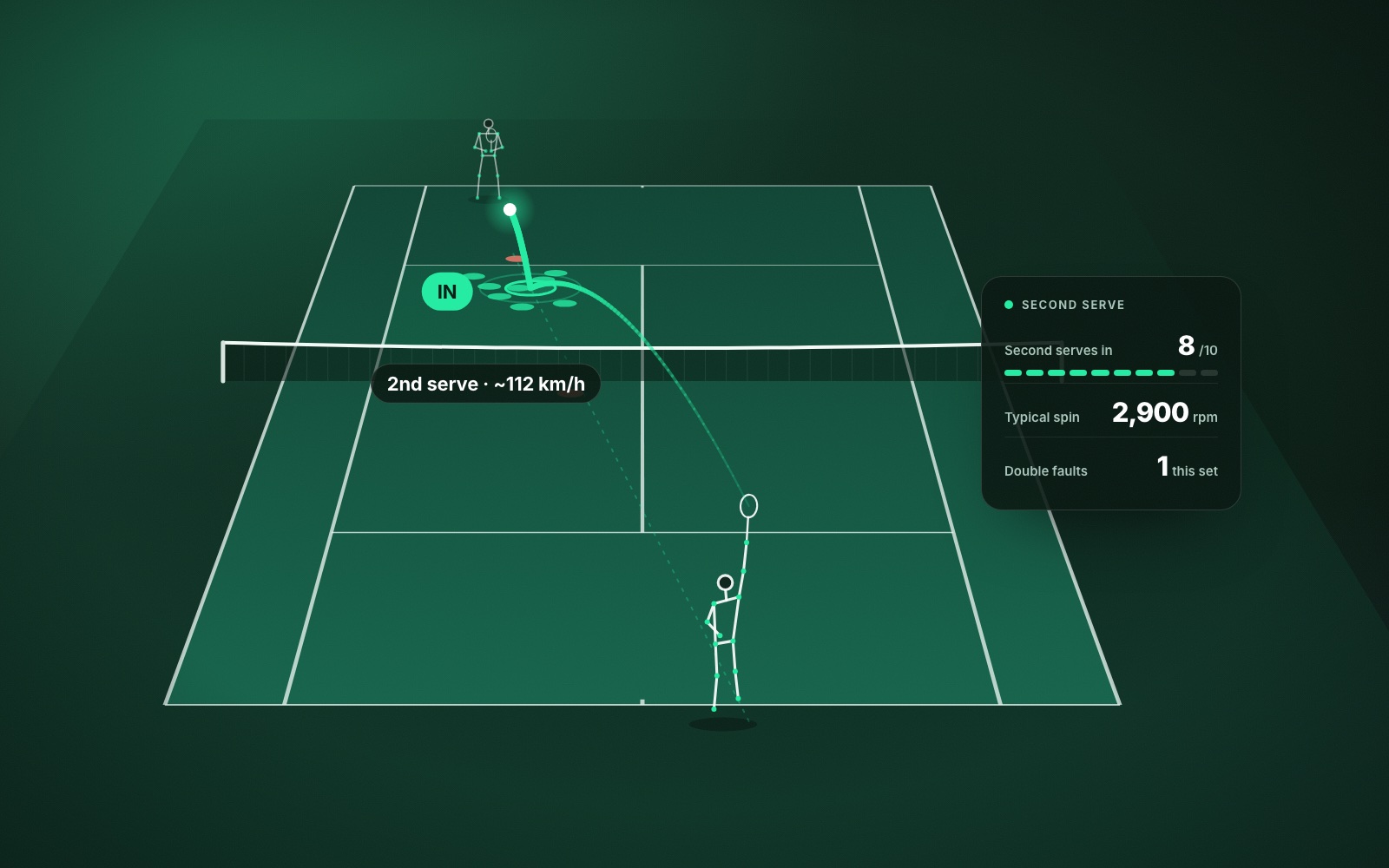
Second serves are usually a good deal slower, because the player trades speed for spin and safety. A gap of 20 to 40 km/h between first and second serve is common at every level.
These bands overlap, and plenty of effective club servers sit at the lower end of theirs. Age, strength, flexibility and how long you have played all move the number.
How club serve speeds compare with the professionals
Leading men commonly average somewhere around 185 to 200 km/h on first serves, with the biggest servers recording individual serves above 220 km/h. Leading women commonly average around 160 to 175 km/h, with the fastest serves above 190 km/h.
Those players are tall, train full time and have hit hundreds of thousands of serves. The gap to club level is normal, and closing it is not the point. Note also that broadcast speeds are measured as the ball leaves the racket. The ball slows considerably through the air and after the bounce, so it reaches the returner much slower than the figure on screen.
What is a good serve speed for you?
A good serve speed is the fastest one you can land in most of the time, in the place you meant it to go.
Consider two servers. One hits 160 km/h and gets four first serves in out of ten. The other hits 135 km/h and gets seven in. The second player starts far more points with a first serve and faces far fewer second-serve returns. At club level the second player usually holds serve more often.
A good serve speed is the fastest one you can land in most of the time.
So the question to ask is not only “how fast?” It is “how fast, how often, and where?”
Why serve speed is not the whole story
Four things decide how hard a serve is to return, and speed is only one of them.
- Percentage. A serve that misses is worth nothing, whatever its speed.
- Placement. A medium-paced serve into the corner or into the body is harder to return than a faster one into the middle of the box at a comfortable height.
- Spin. Slice moves the ball sideways and a kick serve bounces high. Both make a returner uncomfortable without extra speed.
- The second serve. A weak second serve gets attacked, and the fear of that makes players force the first. A dependable second serve is what allows you to swing freely at the first. See how to improve your second serve.
How to measure your tennis serve speed
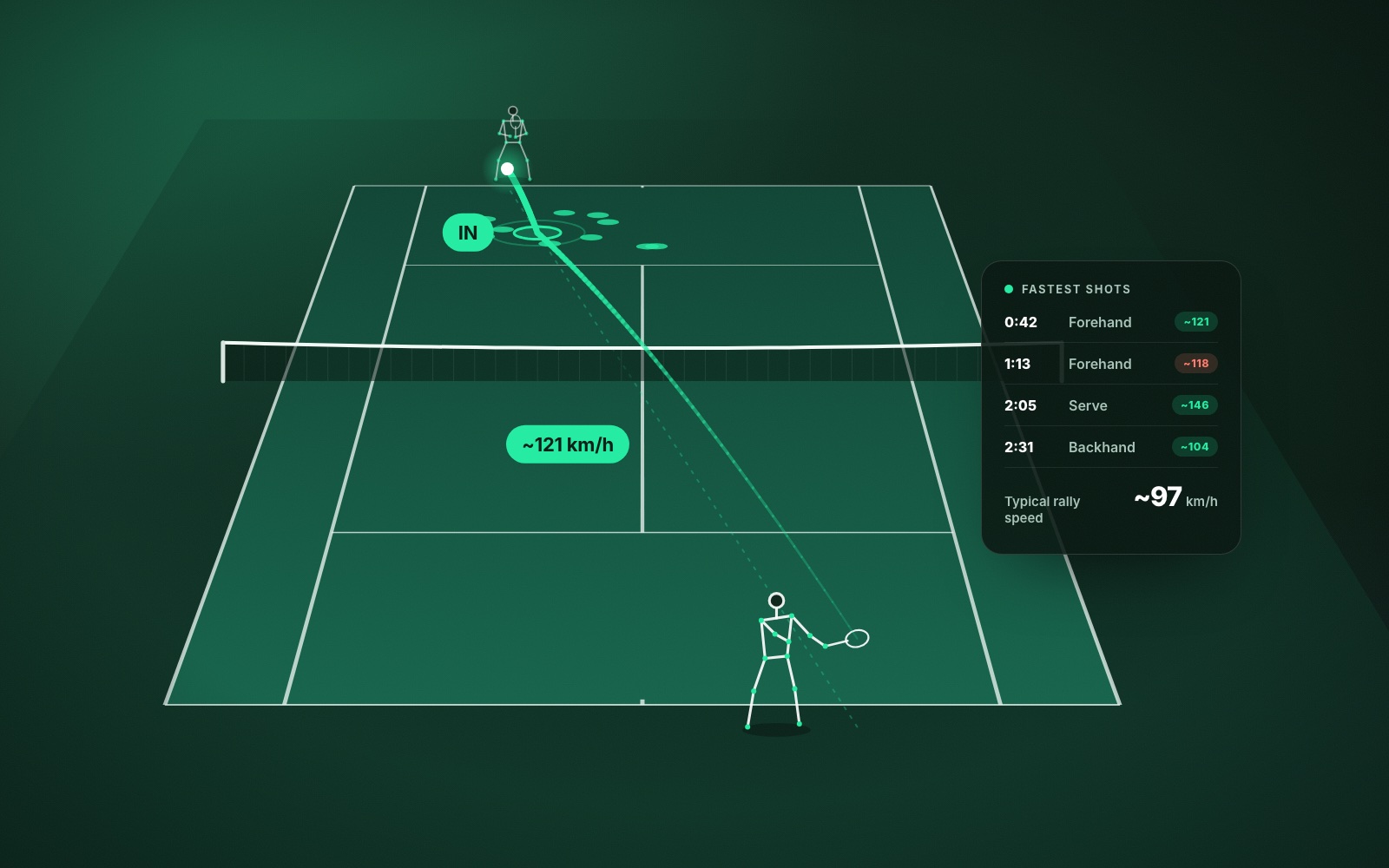
Radar guns work but need someone to hold them and tell you nothing else. An AI video app can estimate speed from the same footage you would film anyway.
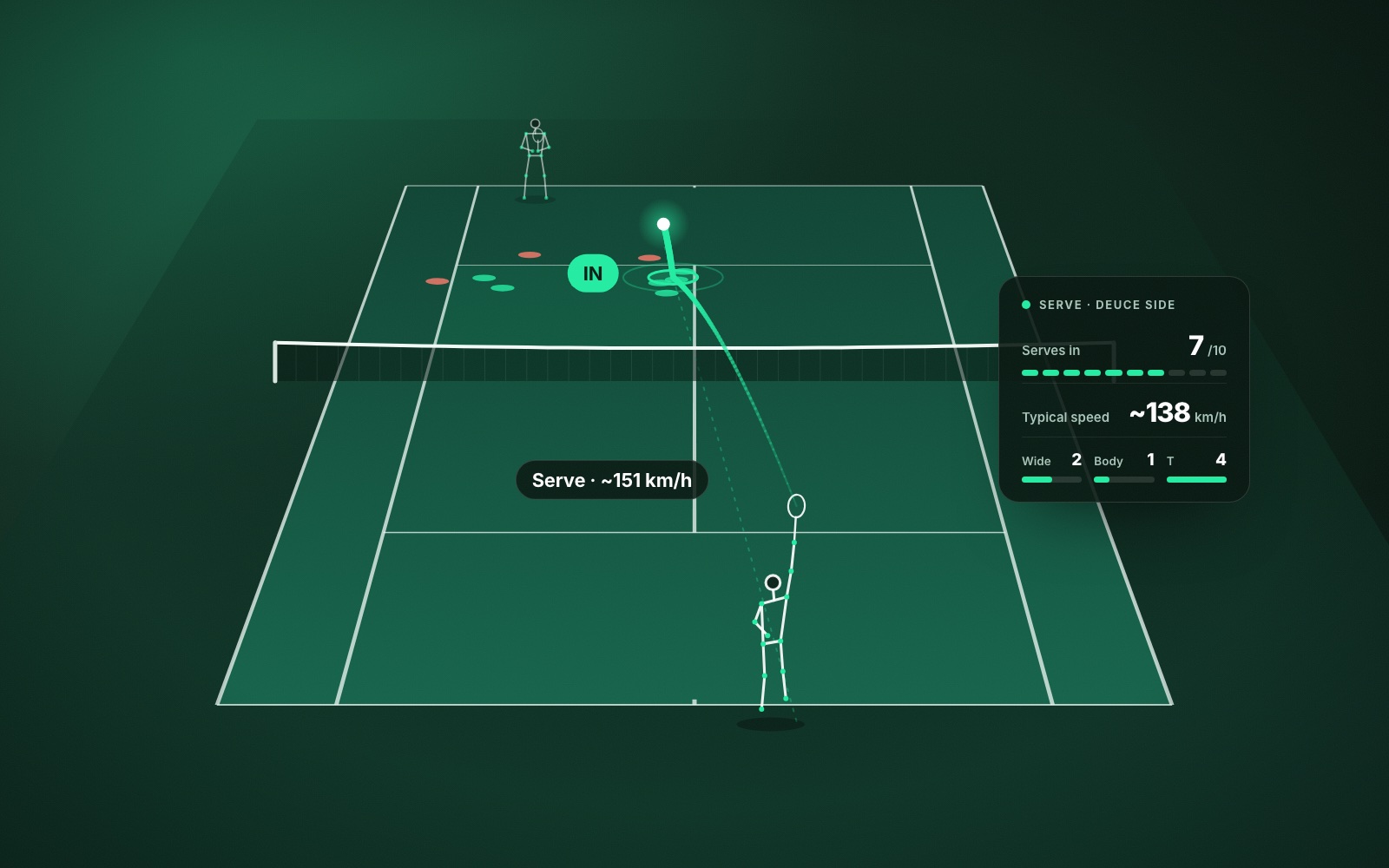
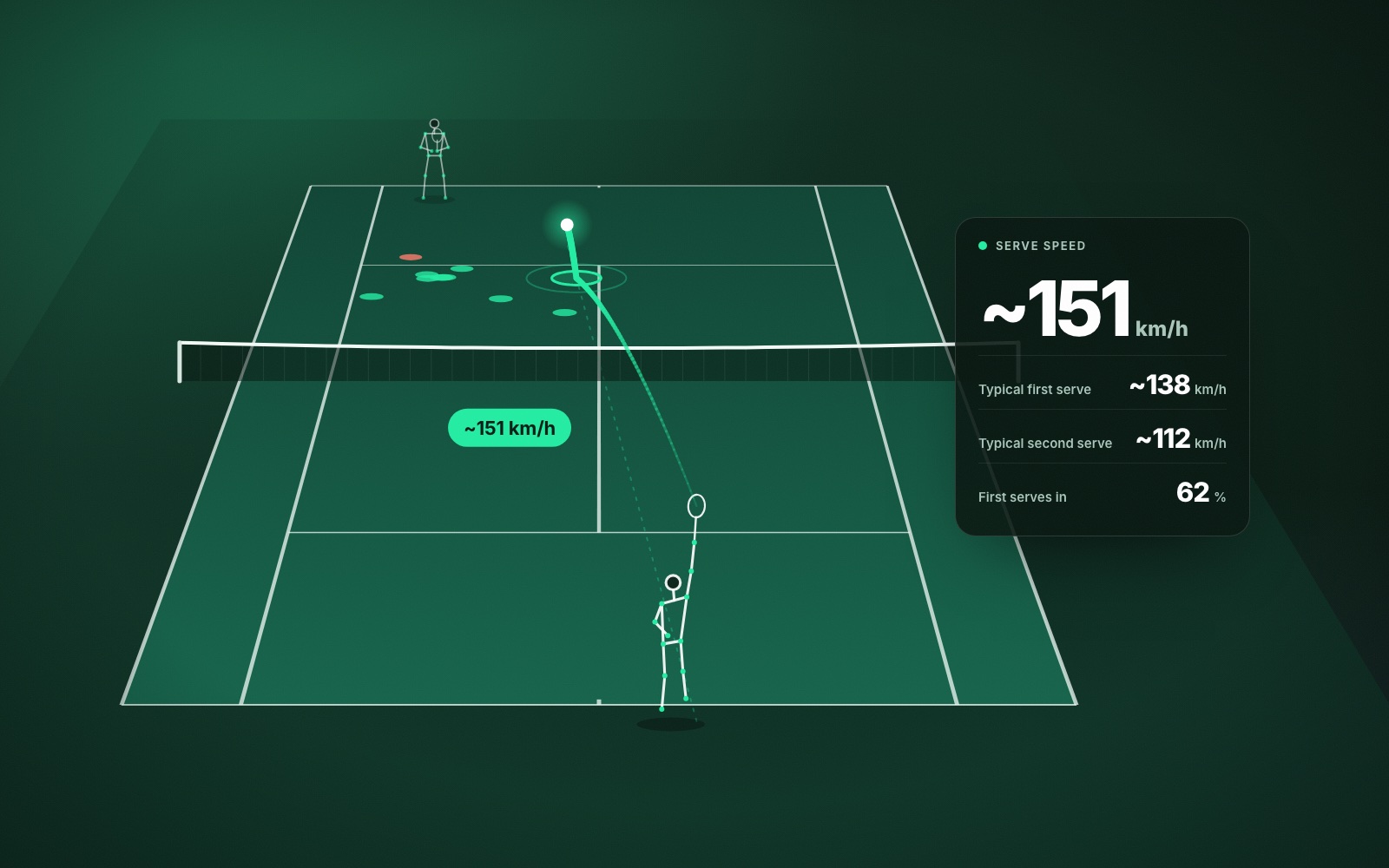
With ContactFrame, you put one phone on a tripod behind the baseline, in landscape, two to three metres back and at net height or higher, and hit serves in a Practice or Match session. For each serve the app shows speed, whether it went in, and where it landed on the deuce and ad sides: wide, body or T. In a match it separates first and second serves.
If ContactFrame is unsure of a speed, it leaves it blank or marks it approximate. You may not get a figure for every serve, but the ones you do get are worth trusting. More on what the recording captures is in what AI tennis video analysis measures.
How to read your serve numbers
Put three figures next to each other: typical speed, serves in, and the spread across wide, body and T.
Say your first serves average 140 km/h but only 45% land in. Speed is not your problem. Taking a little off, or adding spin, to get more in is likely to win you more points than hitting harder.
Say instead that 70% go in at 105 km/h, and nearly all of them land in the middle of the box. You have room to add pace or aim nearer the corners, one change at a time, while watching that the in rate holds.
If your second serve is 50 km/h slower than your first, opponents will be standing well inside the baseline for it. Narrowing that gap with spin, not with risk, is a good project.
How to add serve speed safely
Speed on a serve comes from a relaxed arm, a full motion, leg drive and body rotation, and above all clean timing. Trying to muscle the ball with the arm usually makes it slower and puts more load on the shoulder.
Build up gradually. A sensible session is a set number of serves at a controlled effort, with speed and serves in recorded each time in ContactFrame. Over four to six weeks of regular practice, look for the typical speed creeping up while the in rate stays level. The detail is in how to improve your tennis serve, and the general principles of pace are in how to add power to your shots.
If serving hurts, stop and get it looked at by a qualified professional. Do not push through shoulder or elbow pain for the sake of a number.
What a serve speed number cannot tell you
A speed reading tells you what the ball did. It does not tell you why. ContactFrame does not analyse the ball toss, grip or racket-face angle, and those are often where a coach will start. Pro plan shot mechanics add swing scores for things like preparation, contact, footwork and kinetic chain for the player nearest the camera, with one Next fix to work on, which can point you in a direction. For a serve motion that needs rebuilding, a few lessons are still the quickest route.
Conditions matter as well. Old balls, cold air and a headwind all take speed off. Compare sessions filmed in similar conditions in The Lab, and judge yourself on the trend, not on one windy Tuesday.
Common questions
What is the average tennis serve speed for a club player?
There is no reliable single figure. As a very rough guide, many adult club players hit first serves somewhere between about 100 and 150 km/h, with wide variation by age, level and technique. Second serves are usually noticeably slower.
How fast do professional tennis players serve?
Leading men commonly average around 185 to 200 km/h on first serves, with the fastest going well over 220 km/h. Leading women commonly average around 160 to 175 km/h. Second serves are slower and carry more spin.
Is 150 km/h a good serve?
For most club players, yes, provided it goes in regularly. A 150 km/h serve that lands one time in three is worth less than a 130 km/h serve that lands two times in three and goes where you aimed.
How can I measure my tennis serve speed without a radar gun?
An AI video app can estimate it from a phone on a tripod behind the baseline. ContactFrame shows serve speed for each serve, along with whether it went in and where it landed, and leaves the speed blank or marked approximate if it is unsure.
How do I increase my serve speed?
Speed comes mostly from technique and timing: a relaxed arm, using the legs and body rotation, and clean contact. Build it gradually, keep an eye on how many serves still go in, and see a coach if you want to change your motion.
Find out how fast you really serve.
ContactFrame shows serve speed, serves in and where each one landed, from one phone on a tripod.
Explore the Lab