The short version
- A local league puts you in a division of similar players and gives you a set of matches to play in a fixed window.
- You usually arrange your own matches: the league supplies the opponents, you agree the court and the time.
- On ContactFrame you are placed by your Skill rating, so you do not pick your own division.
- Each ContactFrame division has its own table and group chat, and the top three earn a medal.
- One credit covers one league entry. Joining The Ladder itself is free.
You search for local tennis leagues, UK results come back in a dozen different shapes, and none of them explains what you are signing up for. How many matches? Against whom? Who books the court? If you have only ever played socially, the whole thing can look more formal than it is.
It is not complicated. A league is a way of handing you a short list of opponents at your standard and a reason to play them. This guide covers how a typical local league runs, what a first season feels like, and how leagues work on ContactFrame.
How local tennis leagues work
Almost every local league, whether it is run by a club, a park group or an app, shares the same skeleton.
- Divisions. Players are sorted into groups of similar standard. You play the people in your group, not the whole league.
- A fixed window. There is a start date and an end date. Your matches have to be played between them.
- A table. Results feed a table for each division, so you can see where you stand as the weeks go by.
- Something at the end. A winner, a podium, and in many leagues movement between divisions for the next round.
The format is usually singles, and matches are usually arranged by the players themselves. That last part surprises people. Nobody sends you a fixture for Tuesday at seven. You get a list of names and you sort it out between you.
What to expect from tennis leagues near you
The details vary, so read the rules of any league before you enter. But a few things are close to universal.
You will arrange your own matches. This is the main skill of league tennis, and it has nothing to do with your backhand. Message everyone in your division in the first few days. Offer two or three specific times, not “whenever suits”. Players who do this finish their matches. Players who wait to be asked end up chasing three opponents in the final week.
You will need a court. Some leagues are tied to one venue. Many are not, and the two of you pick somewhere fair to both. If you do not have a regular place to play, it is worth sorting that out first: our guide to finding tennis courts near you covers public and pay-and-play options.
You will call your own lines. There is no umpire. Each player calls the balls on their own side, and a ball you are not sure about is in. If you have not played a competitive match before, read up on etiquette for local matches. It takes ten minutes and saves a lot of awkwardness.
You will lose some. A well-sorted division is meant to be close. If you win every match easily, the division was wrong for you. Expect a mix, and expect to learn more from the tight losses than from anything else you do that month.
Why divisions matter more than anything else
A league stands or falls on how well it sorts people. Put a strong player in a weak division and nobody enjoys it: one person collects easy wins and the rest lose badly several times.
Many leagues sort new players by asking them to describe their level. That works roughly, but people are poor judges of their own standard, in both directions. Someone back from ten years off calls themselves a beginner and flattens the bottom division. Someone who has had a block of lessons calls themselves advanced and has a miserable season.
The alternative is to sort by results. That is the approach ContactFrame takes, and it is the reason the league there sits on top of a rating. If you want the background, how the Skill rating works explains what the number is for.
How ContactFrame leagues work
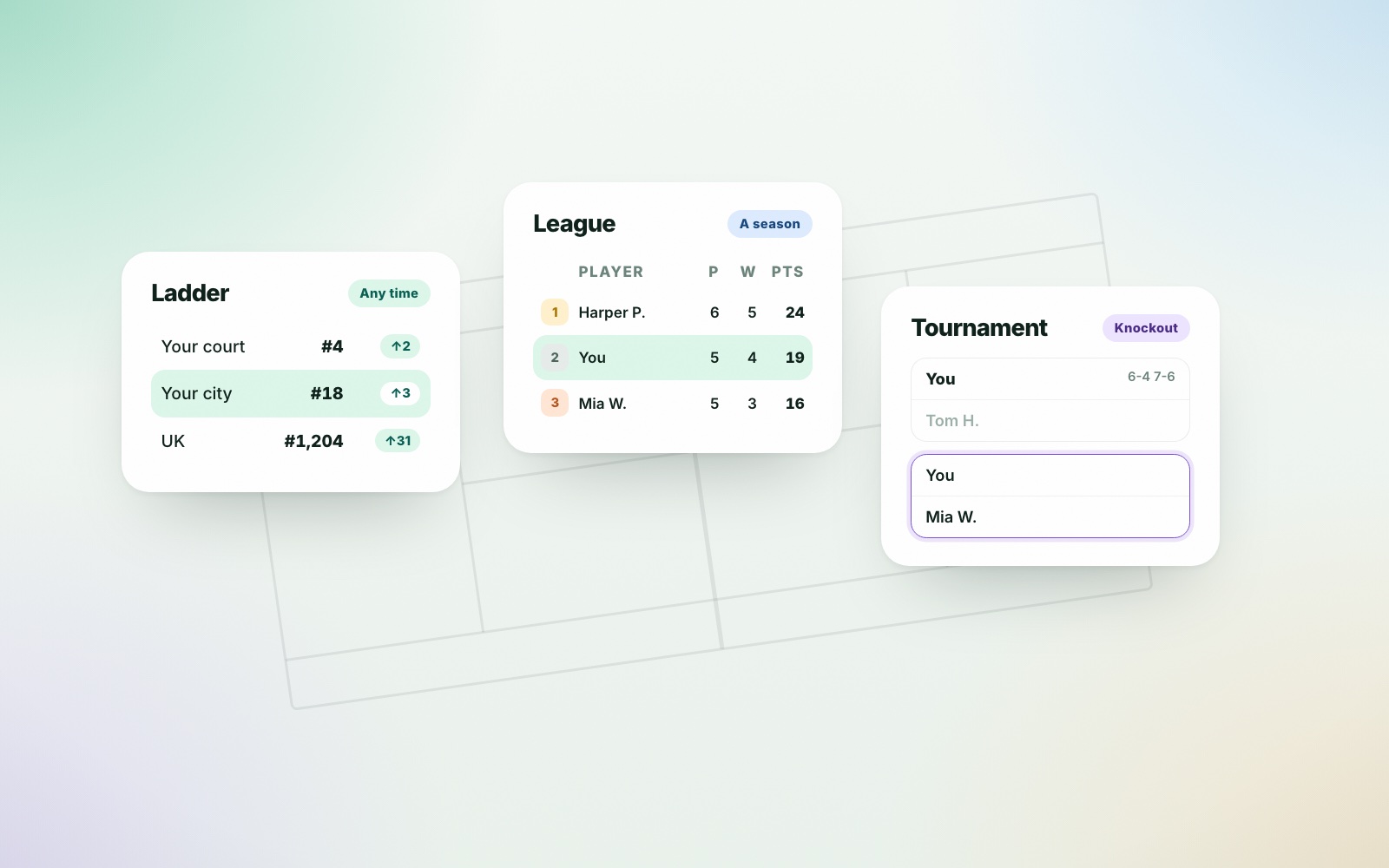
ContactFrame’s competition side is called The Ladder, and it is UK only. Leagues are one part of it.
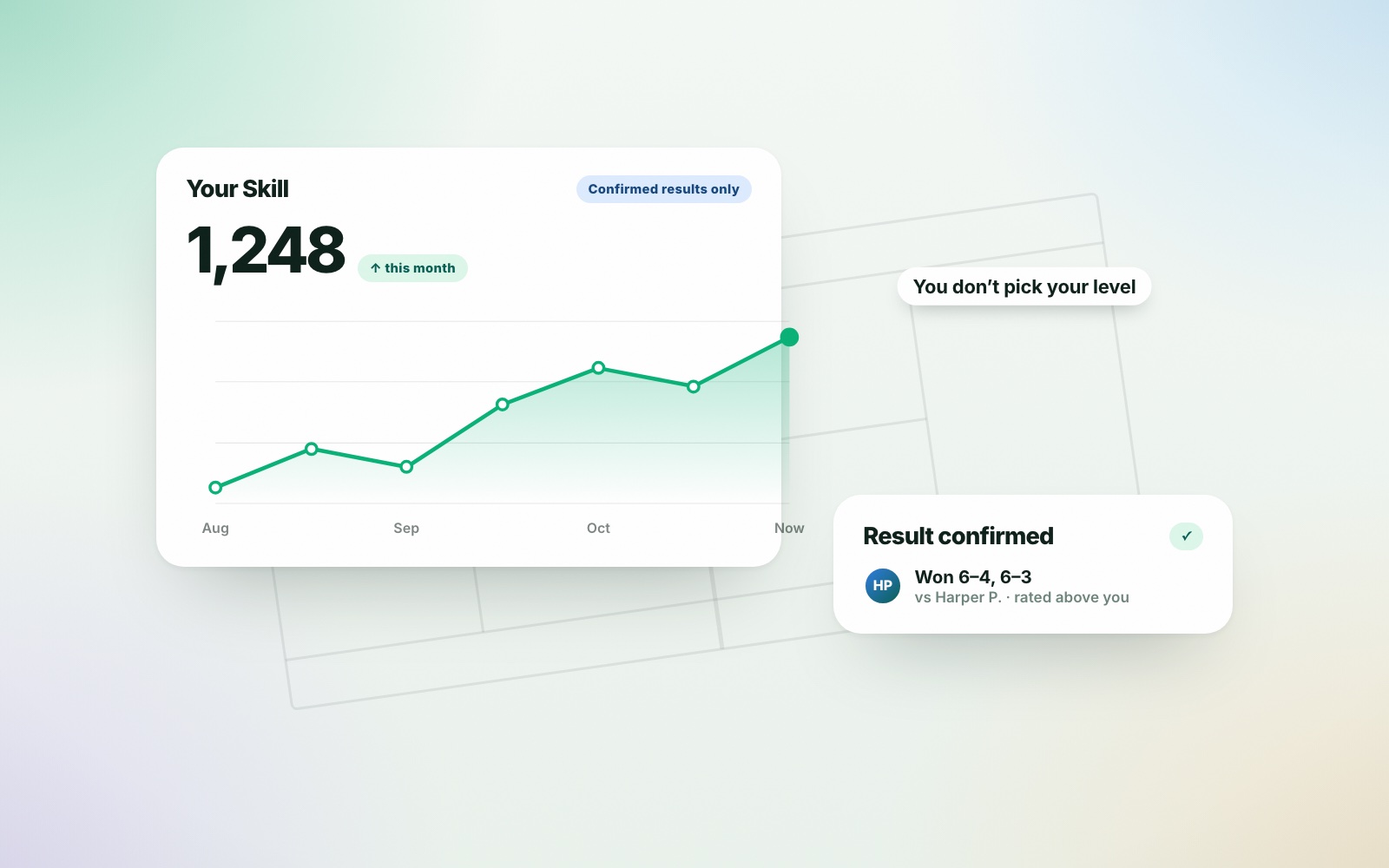
You are placed, you do not choose. When you enter a league, ContactFrame puts you in a division with players at your level, using your Skill rating. That rating is built from confirmed results, so the more you have played, the better the fit.
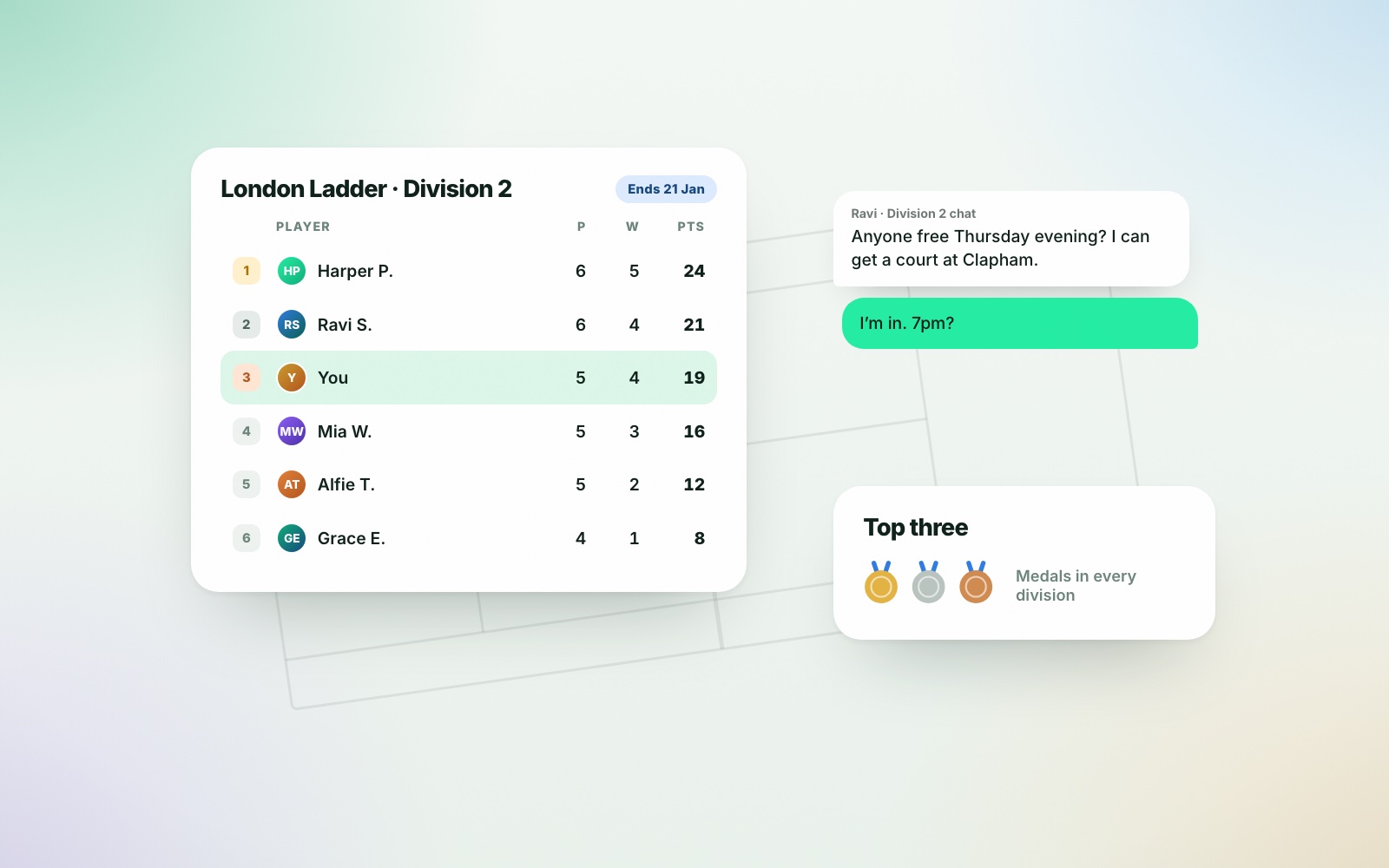
Each division has its own table. You see your division, your opponents and where everyone stands as results come in.
Each division has its own group chat. This is where matches get arranged. Fixture and result cards appear in the thread, so the conversation and the outcome live in the same place. There is also a chat for each individual match, which keeps the “are you free Thursday” messages out of everyone else’s way.
Results are confirmed by both players. One of you logs the result and the other confirms it. A result that nobody disputes is confirmed automatically after 24 hours, so a table is never stuck waiting on one person. The full process is in how to log and confirm a result.
The top three earn a medal. In every division, not only the top one. The medal goes on your profile alongside any achievements and trophies.
One credit, one entry. Joining The Ladder, playing friendlies and appearing in the rankings are free. Entering a league costs one credit. The Basic and Pro plans include credits each month, and you can also buy five for £20. Plans are listed on the pricing section.
Is a league the right format for you?
A league suits you if you want a steady run of matches against a known group, and you are happy to do a little organising. It rewards showing up week after week more than one great day.
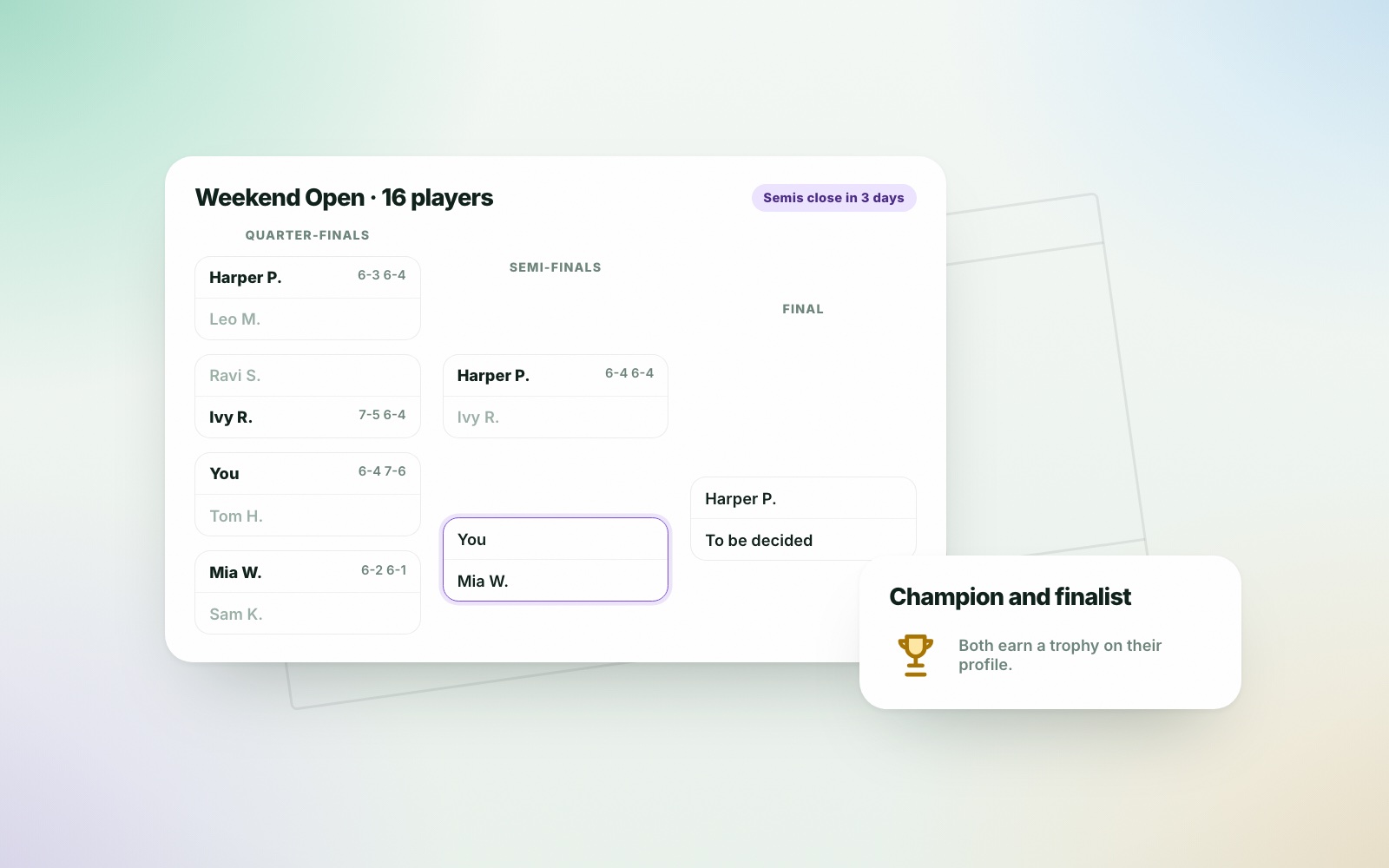
It suits you less if your diary is unpredictable. In that case a single friendly, arranged when you happen to be free, is a better fit, and a knockout suits people who like a bit of jeopardy. We compare all three in ladder vs league vs tournament.
Many players do both: friendlies to build a rating and meet people, then a league once they know roughly where they stand.
Getting ready for your first league
- Get some results on the board first. A few confirmed matches before you enter mean your division placement has something to go on.
- Set a home court. It makes it easier for opponents to suggest somewhere sensible, and you can see who else plays there.
- Message the division on day one. Introduce yourself and post your available times.
- Log each result on the day. It keeps the table current and it is one less thing to remember.
- Look at the table at halfway. If you have matches left and the window is closing, chase them now.
That is all there is to it. The tennis is the same tennis you already play. The league adds a few names, a deadline and a table, and for most people that is exactly the push that turns “we should play sometime” into an actual match. When you are ready, join The Ladder and get the app when it lands.
Common questions
How do local tennis leagues work in the UK?
Players are grouped into divisions of similar standard and play the others in their division over a set period. Most local leagues leave it to the two players to agree a court and a time, then record the score so the table updates.
Do I need to be a club member to join a local tennis league?
Not always. Club leagues are normally for members, but park leagues and app-based leagues are open to anyone who can get to a court. ContactFrame leagues are open to players anywhere in the UK and do not require a club membership.
What standard do I need to be to play in a tennis league?
You need to be able to serve, rally and keep score. Beyond that, divisions exist so that players of any standard get even matches. On ContactFrame your division is set by your Skill rating, which comes from confirmed results.
How much does it cost to enter a ContactFrame league?
One credit covers one league entry. Credits come with the Basic and Pro plans each month, or you can buy five for £20. Joining The Ladder, playing friendlies and using the court finder are free.
What happens if I cannot arrange a league match?
Start early and offer several times rather than one. Most unplayed league matches come from both players waiting until the last week. Use the division chat to get dates agreed in the first few days.
A division at your level.
Join the UK ladder, get a Skill rating from real results and enter a league when you are ready.
Explore the ladder