The short version
- A knockout halves the field every round: win and you move on, lose and you are out.
- Seeding keeps the strongest entrants apart early, so the later rounds are the closest ones.
- ContactFrame tournaments are seeded by Skill, with the first round drawn close to home.
- Every round has a deadline. A match still unplayed when it passes is decided at random, and the result says so.
- The champion and the finalist each earn a trophy. One credit covers one entry.
Most information about tennis tournaments for adults in the UK assumes you already know how one works. You are told to “enter the draw” as though the draw, the seeds and the walkover were common knowledge. If the last tournament you played was at school, or you have never played one, the format itself is the barrier.
This guide explains the knockout from the beginning: what a draw is, why some players are seeded, why rounds have deadlines and what happens when a match does not get played. Then it covers how tournaments run on ContactFrame.
How a knockout tennis tournament works
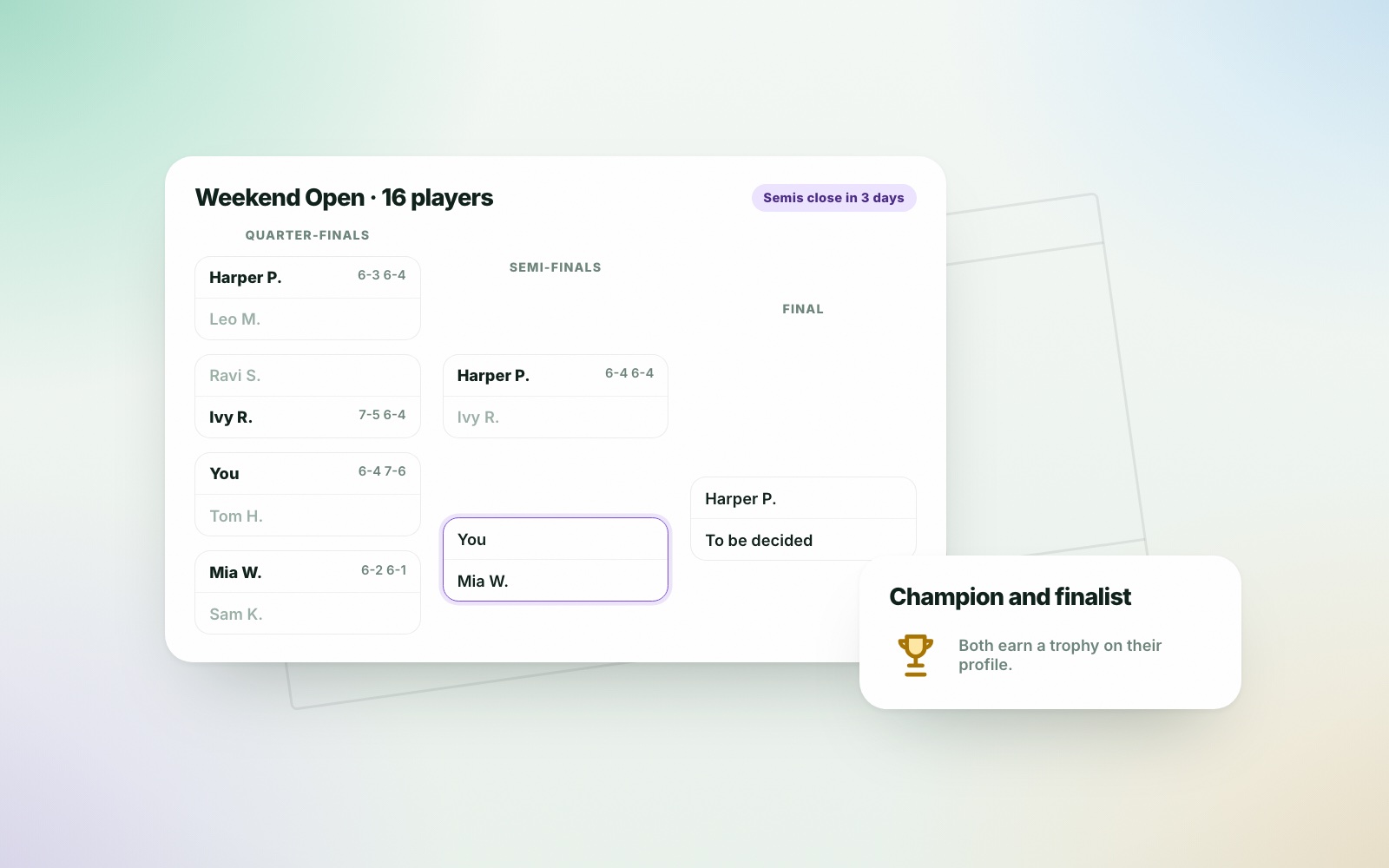
A knockout, also called single elimination, is the simplest competition there is. Everyone is paired off. Winners go through to the next round and are paired again. Losers are out. This repeats until two players are left, and they play the final.
The draw is the bracket that sets out who plays whom. Once it is published you can trace your path: your first opponent, the two players one of whom you would meet next, and so on to the final.
Because the field halves each round, the numbers work most neatly when the entry is a power of two. When it is not, some players are given a bye, which is a free pass through the first round. Byes are normally given to the top seeds.
What seeding is for
If a draw were pulled entirely out of a hat, the two best players could meet in round one. One of them would go home after a single match, and the final might be badly one-sided.
Seeding prevents that. The strongest entrants are identified before the draw and placed in separate sections, so they can only meet late on. The top two seeds go in opposite halves and cannot play each other before the final.
Seeding is not a favour to the good players. It protects everyone else too. An unseeded player has a fairer run when the favourites are spread out and not stacked in one corner of the bracket.
Of course, seeding is only as good as the information behind it. Seed by self-described level and you get a draw built on guesswork. Seed by results and the bracket means something. That is why a rating matters here: see how the Skill rating works for what ContactFrame’s number is for.
Why every round needs a deadline
At a weekend event held at one venue, the schedule is fixed: you are told a court and a time. Many adult tournaments do not run like that. They are spread over several weeks, and the players arrange each match themselves.
That is far easier to fit around work and family. It also creates the classic knockout problem. In a league, one unplayed match leaves a gap in the table. In a knockout, one unplayed match stops everything behind it. The next round cannot be drawn up until the winner is known, so two slow players can hold up the whole bracket.
Deadlines fix that. Each round has a date by which the match must be played. What happens when the date passes varies from event to event, so always check. Traditionally the player who could not or would not play concedes a walkover, and the opponent goes through without hitting a ball.
How ContactFrame tournaments work
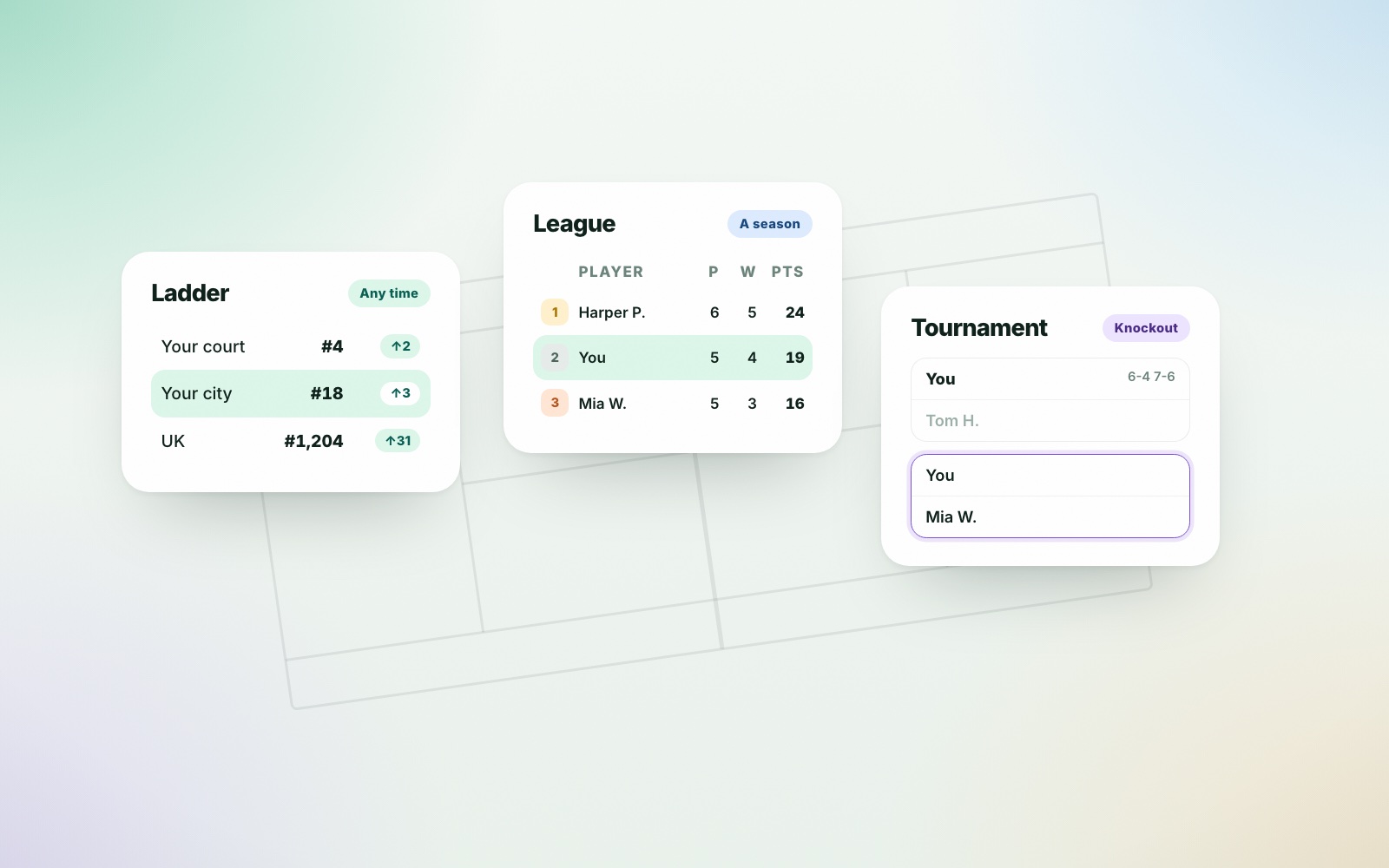
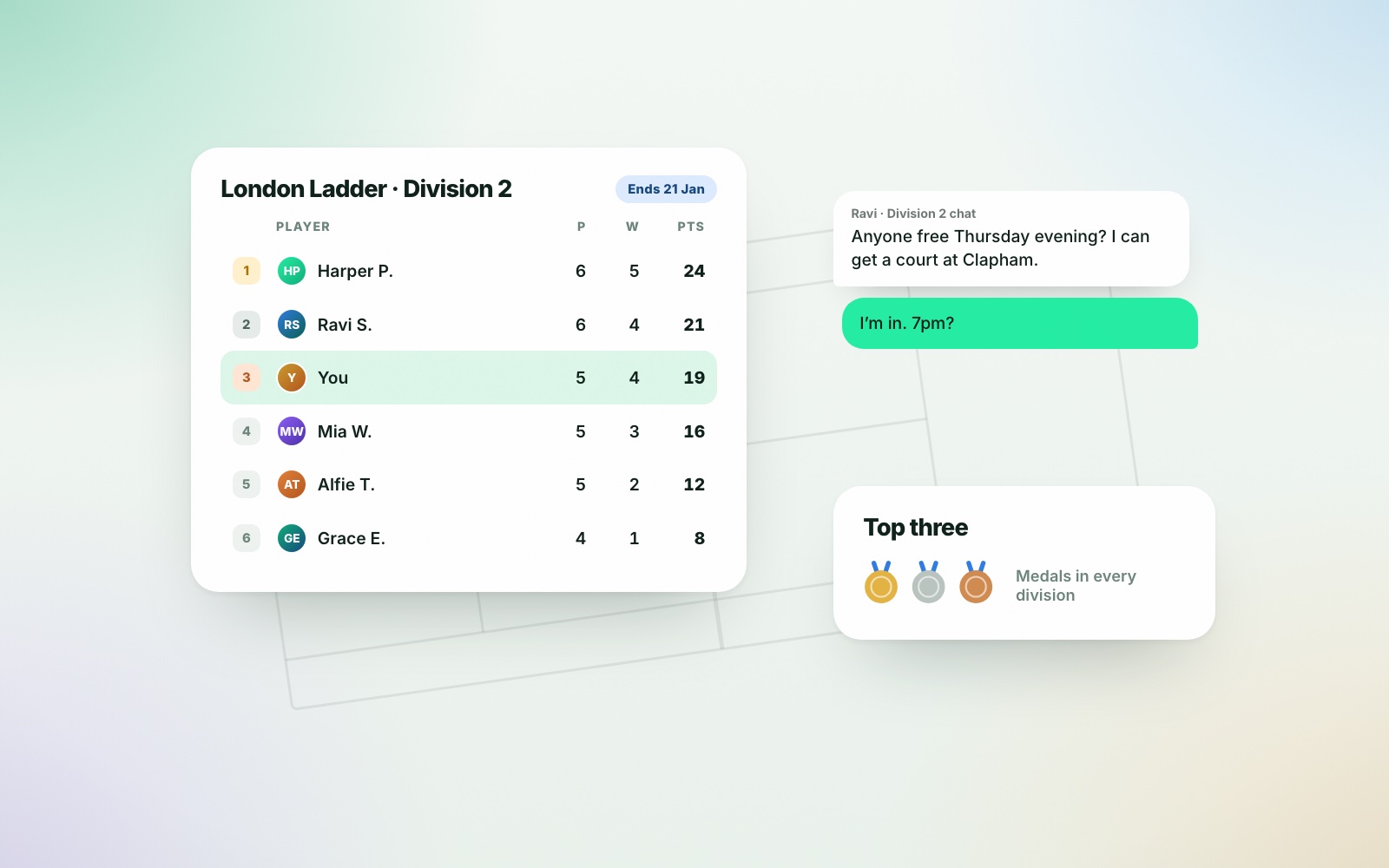
Tournaments are part of The Ladder, ContactFrame’s competition side, which covers the UK.
Draws are seeded by Skill. Your Skill rating is built from confirmed results and you do not choose it, so the seeds reflect what has happened on court.
The first round is drawn close to home. Nobody wants an opening match that needs half a day of travel. Your first opponent is drawn near you, which makes that first match much easier to arrange.
Every round has a deadline. You and your opponent agree the court and time between you, using the chat for that match, and you play before the date shown.
The draw always finishes. A match still unplayed at the deadline is decided at random, and the result says so. It will not look like a win earned on court, because it was not one. The point is that everyone else in the bracket gets to carry on.
Results are logged and confirmed. One player logs the result and the other confirms it. If nobody disputes it, it is confirmed automatically after 24 hours.
Two trophies. The champion and the finalist each earn a trophy, shown on their profile.
One credit per entry. Joining The Ladder is free. Entering a tournament costs one credit, and credits come with the Basic and Pro plans or in a pack of five for £20.
Playing your first adult tennis tournament
A knockout feels different from a league or a friendly, and it helps to know that going in.
The first round is the hardest. There is no second chance and no table to recover in. Nerves are normal. A simple plan helps more than an ambitious one: get first serves in, aim well inside the lines and make your opponent hit one more ball. Our piece on preparing for a match goes through this in detail.
You might play a seed early. If you are unseeded, you may meet a stronger player in the first or second round. Treat it as a free hit. You have little to lose, and a rating built on results rewards an upset.
You might only play once. Half the field does. If one match feels like poor value, pair the tournament with a league or a few friendlies so there is always another match in the diary. We compare the formats in ladder vs league vs tournament.
Know the etiquette. You call your own lines, you agree the format before you start and you shake hands at the end whatever happened. If any of that is new, etiquette for local matches is a short read.
Is a tournament right for you?
Tournaments suit players who like a clear stake. Every match matters, the path to the final is visible from the start, and there is a real winner at the end.
They suit you less if what you want is volume. A knockout guarantees one match and no more. If you are new to competing altogether, starting competitive tennis as an adult suggests an order to try things in, and a tournament is rarely the first step.
When you do enter one, the experience is hard to get any other way: a match where the result decides whether you play again next week. Plenty of adults find it is the format that makes them practise properly. You can join the list for the app on the Ladder page.
Common questions
Can adults enter tennis tournaments in the UK without being in a club?
Yes. Alongside club championships there are open events and app-based tournaments that anyone can enter. ContactFrame tournaments are open to players on its UK ladder and do not require a club membership.
How does seeding work in a tennis tournament?
The strongest entrants are placed in different parts of the draw so they cannot meet in the first rounds. On ContactFrame the seeding comes from each player’s Skill rating, which is built from confirmed results.
What happens if a tournament match is not played in time?
It depends on the event. On ContactFrame, a match still unplayed at the round deadline is decided at random so the draw always finishes, and the result is marked to show that is how it was decided.
How many matches will I play in a knockout tournament?
At least one, and one more for every round you win. That is the trade-off with a knockout: half the field plays a single match, while the finalists play every round.
How much does it cost to enter a ContactFrame tournament?
One credit covers one tournament entry. Credits are included each month with the Basic and Pro plans, or you can buy five for £20.
A draw that always finishes.
Join the UK ladder, build a Skill rating and enter a knockout near you.
Explore the ladder